

How Cold Chain Creates Value for Africa’s Food Retail?
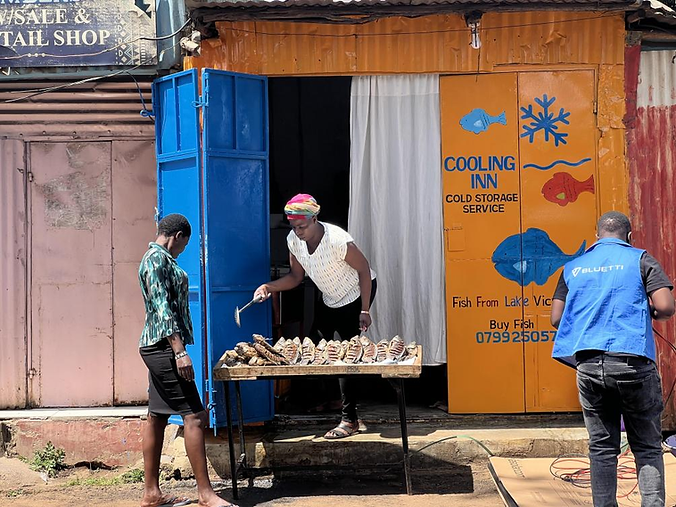
Cooling Inn: Reshaping Nodes with 'Cooling as a Service'

Dorothy, who runs a fried fish shop in the Kibera slum of Nairobi, used to travel over 20 kilometers daily to buy fresh fish from a wholesale market. Without refrigeration equipment, she could only buy 10 kilograms at a time, and even then, nearly one-third of the fish would spoil in the heat. Dorothy’s struggle is a snapshot of Africa’s fresh food supply chain: a long and fragmented process that not only drives up retail prices but also causes severe resource waste.

Women buying and selling fish at Nairobi’ s Gikomba Market
01
Supply Chain Breakdown:
The Absence of Cold Chain in Africa’s Retail Network

Africa’s fresh food retail has long been constrained by an inefficient supply chain. In Kenya’s fisheries sector, for example, the traditional chain involves multiple intermediaries—fishermen, wholesalers, and retailers. According to The New Yorker 100, refrigeration increases product costs by only about 1% in developed countries, but around 30% in developing ones[1]. In 2021, about 13% of food was lost in the supply chain between harvest and the point of sale[2].
In Kenya, small merchants like Dorothy often earn around $5 per day, a large portion of which is spent on storage or covering losses. Inefficiencies aren't just economic: female vendors spend 1.5 to 3 hours daily on procurement trips—time that could otherwise go to business or family. Without preservation tools, they are also forced to sell products at a discount, further squeezing their profit margins.
So, the logic behind solving their problem is remarkably simple—reduce the spoilage rate of fresh food and extend the time available for sales.
02
Cooling Inn
Reshaping Nodes with
“Cooling as a Service”
Under the Prometheus Africa Essential Retail Project Phase I, the Cooling Inn project proposes a new solution: transforming refrigeration from a mere preservation tool into a key retail channel node through “Cooling as a Service” (CaaS). The model includes several key ideas:
Hardware Penetration
and Strategic Placement
Cooling Inn installs solar-powered freezers near fishing villages and fish markets.
Shortening the Chain
and Improving Efficiency
Fishermen at Lake Victoria can now schedule storage via mobile phone, avoiding trips to wholesale markets. Fish wholesalers can store their catch locally, significantly reducing spoilage and ensuring freshness.
Transparent Billing and Data-Driven Operations
Each freezer connects to Prometheus’s ERP system, automatically tracking storage weight and duration to generate precise invoices. One fisherman noted: “Now I can predict which type of fish will sell best next week.” This data-driven, on-demand fishing model has been shown to reduce catch volumes while increasing income.
Community Sharing
and Ecosystem Activation
In Nairobi’s Kibera community, the freezer has become a hub of collaboration. Neighbors share the unit, taking on roles like fish storage, cold drink sales, and delivery services—each boosting their average daily income.
Unlike traditional hardware sales, Cooling Inn’s revenue model is based on service fees—charged per kilogram per day—tying costs to actual usage. This low-barrier rental model eliminates the need for costly equipment purchases, significantly lowering startup costs. In the Kakuma refugee camp, women who previously couldn’t afford equipment now operate viable retail outlets thanks to Cooling Inn. Meanwhile, for Prometheus, every community freezer becomes a stable source of recurring service fee revenue—ensuring sustainable cash flow.
After several months of pilot testing, Cooling Inn’s value has extended far beyond hardware. The cold storage units are now connecting fishing villages with community retailers—from supply to sales—gradually forming a traceable and manageable cold chain network at the community level.This not only ensures freshness but also opens new retail pathways at the grassroots level. More importantly, IoT-connected devices continuously record operational and transaction data, building a valuable real-time data asset. These datasets are now being used to improve inventory forecasting, support equipment financing and installment payment models, and even explore blockchain integration.
03
From Single Points to Network
The Value of Data Assets

At UN MSME Day 2025: Harnessing Green Innovation for MSME Resilience, Advancing the SDGs, Zhang Xiaowen, founder of the Prometheus Africa Essential Retail Project, shared the project's progress and achievements
04
Looking Ahead
Cold Chain as Community Infrastructure
The essence of the Cooling Inn model lies in transforming cold chain hardware into a channel node that connects supply and demand, carries data, and generates value—through “Cooling as a Service” and low-barrier leasing. It redefines the logic of community fresh food supply chains: shortening the chain, reducing losses, improving efficiency, and creating new opportunities.
As Dorothy’s experience shows: she no longer worries about fish spoilage, her procurement frequency has decreased, and yet her order volume has significantly increased. For investors, this is more than a hardware project. It’s a case study in how to use technological innovation and business model transformation to reshape traditional distribution channels and unlock the potential of emerging markets.
References
[1] Nicola Twilley, 2022, Africa’ s Cold Rush and the Promise of Refrigeration https://www.newyorker.com/magazine/2022/08/22/africas-cold-rush-and-the-promise-of-refrigeration?utm_source=chatgpt.com
[2] FAO, Responsible consumption and production, 2023 https://openknowledge.fao.org/server/api/core/bitstreams/3a8baf8c-960d-4105-9538-e4bd9b1d4503/content/cc7088en.html#/12